

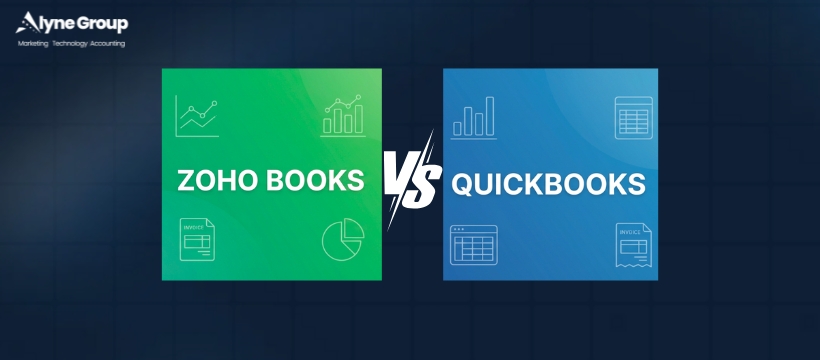
Choosing accounting software is not just a technical decision anymore. It directly shapes how your business tracks revenue, manages cash flow, and scales operations. In most cases, the real debate comes down to Zoho Books vs QuickBooks.
Both are powerful, both are widely used, but they are built with very different mindsets. One focuses on connected business automation, and the other focuses on traditional accounting strength.
This guide breaks down both tools in a practical way so you can actually understand which one fits your business, not just which one has more features.

Overview of Both Platforms
Zoho Books

Zoho Books is a cloud-based accounting platform designed as part of the larger Zoho ecosystem. It is built for businesses that want automation, integration, and connected financial workflows.
It works especially well when combined with:
-
Zoho CRM integration
-
Zoho Inventory
-
Zoho Subscriptions
-
Zoho Analytics
-
Zoho One marketing automation
Because of this ecosystem approach, many businesses implement it with the help of a zoho consulting partner or zoho experts to ensure proper setup and workflow design.
QuickBooks
QuickBooks is a widely used accounting software developed by Intuit. It is primarily focused on bookkeeping, taxation, and financial reporting.
It is known for:
-
Strong accounting structure
-
Tax compliance features
-
Widely accepted bookkeeping standards
-
Familiarity among accountants
Unlike Zoho Books, it functions more as a standalone accounting system and relies heavily on third-party integrations for extended capabilities.
The Core Difference You Should Understand First
The key difference between the two platforms lies in how they approach accounting.
Zoho Books Approach
Zoho Books treats accounting as part of a connected business ecosystem. Finance is not isolated; it is linked directly with sales, CRM, and operations.
This is where zoho crm integration becomes important, as it connects customer data directly with financial workflows and reporting.
QuickBooks Approach
QuickBooks focuses primarily on accounting accuracy and compliance. It is designed to function independently, with integrations added externally when needed.
Where Zoho Books Feels More Modern

Zoho Books stands out when businesses want automation and integration rather than manual accounting work.
Instead of treating finance as a separate function, it connects naturally with:
-
Zoho CRM integration for linking customer data with invoices and payments
-
Zoho Inventory for stock and order tracking
-
Zoho Subscriptions for recurring billing models
-
Zoho Analytics for deeper financial reporting
-
Zoho One marketing automation for end-to-end business visibility
This is what makes Zoho Books feel less like accounting software and more like a full business control system.
For growing companies, especially SaaS or service-based businesses, this connection matters a lot because revenue tracking is not isolated anymore, it is tied to customer journeys.
This is where zoho crm consulting and zoho experts become important, because setting up these connections properly changes how the entire business operates.
Zoho Books vs QuickBooks: Quick Comparison

Feature Comparison
Instead of listing features mechanically, here’s how they actually feel in day-to-day use.
1. Accounting and Bookkeeping
Zoho Books reduces manual work through automation rules. Transactions can be categorized automatically, invoices can be recurring, and bank reconciliation becomes more streamlined.
QuickBooks, on the other hand, gives accountants more control and structure. It feels more “hands-on,” which some finance teams actually prefer.
2. Invoicing and Billing
Zoho Books is more flexible here. If your business runs on subscriptions, retainers, or recurring billing, it handles those flows naturally.
QuickBooks handles invoicing well too, but it feels more standard and less customizable in terms of automation logic.
3. Automation and Workflow Thinking
Zoho Books is built around automation. Businesses can create workflows for approvals, billing, and notifications. When combined with zoho one marketing automation, it enables seamless coordination between marketing, sales, and finance.
Key automation strengths include:
-
Invoice automation
-
Approval workflows
-
CRM-triggered financial actions via zoho crm integration
QuickBooks offers limited automation, mostly focused on repetitive accounting tasks like invoice reminders and recurring billing.
4. Reporting and Visibility
Zoho Books provides real-time dashboards that offer visibility into cash flow, expenses, and revenue. When integrated with Zoho Analytics, it becomes a powerful financial intelligence system.
QuickBooks provides strong standard financial reports such as:
-
Profit and loss statements
-
Balance sheets
-
Tax summaries
However, advanced analytics typically require external tools.
5. Integration Approach
This is one of the biggest decision points.
Zoho Books connects natively with the entire Zoho ecosystem. That means your CRM, finance, operations, and growth marketing tools all speak the same language.
QuickBooks integrates with a large number of third-party tools like Stripe, PayPal, and Shopify. But the difference is that these are connected systems rather than one unified ecosystem.
This is why businesses working on scaling often rely on zoho consulting experts to design the entire system properly instead of just installing software.

Scalability: Where You Are Headed Matters
If your business is going to stay small and focused only on accounting, QuickBooks is enough.
But if you are planning to grow, add sales teams, marketing automation, CRM systems, and reporting layers, Zoho Books becomes more valuable over time.
With Zoho Books, you don’t just scale accounting. You scale the entire business system around it.
That’s also why companies often work with a zoho crm partner or zoho consulting partner, because implementation becomes architecture, not just setup.
So Which One Should You Actually Choose?
Here’s the simplest way to look at it:
Choose Zoho Books if:
-
You want automation across business processes
-
You already use or plan to use Zoho CRM
-
You want finance connected with sales and marketing
-
You are building a scalable, system-driven business
-
You want help from zoho crm consulting or zoho experts
Choose QuickBooks if:
-
You want simple, standalone accounting
-
Your accountant already uses QuickBooks
-
Your focus is mainly tax and compliance
-
You don’t need CRM or zoho marketing integration
Why Alyne as a Zoho Partner Makes the Difference

Choosing the right platform is only the first step. The real impact comes from how it is implemented, customized, and optimized over time. This is where Alyne plays a key role as a trusted zoho consulting partner and zoho CRM partner.
Alyne helps businesses move beyond basic setup and build a fully connected financial ecosystem using Zoho Books and the broader Zoho suite.
As a Zoho implementation and consulting partner, Alyne enables:
-
End-to-end Zoho CRM integration with accounting systems
-
Customized workflows tailored to business models
-
Seamless migration from tools like QuickBooks to Zoho Books
-
Advanced automation using Zoho One marketing automation
-
Scalable financial dashboards using Zoho Analytics
-
Continuous optimization through expert zoho consulting support
Instead of treating Zoho Books as just accounting software, Alyne positions it as the financial backbone of a fully connected business system.
This approach ensures that businesses are not just using software, but actually building a scalable revenue operations framework.
Conclusion
The comparison between Zoho Books and QuickBooks is ultimately a comparison between two philosophies.
QuickBooks represents traditional accounting systems that prioritize structure, compliance, and standalone financial management.
Zoho Books represents modern business systems that combine accounting with CRM, marketing, and operations through deep integration and automation.
For businesses looking to grow beyond basic bookkeeping and build a connected digital ecosystem, Zoho Books offers a more future-ready approach, especially when implemented with the right guidance.
And this is where Alyne becomes the differentiator. With strong expertise in zoho consulting, zoho CRM consulting, and Zoho CRM integration, Alyne ensures that businesses don’t just adopt Zoho Book, they transform how their entire revenue and financial system works.

Frequently Asked Questions (FAQs)
1. What is the main difference between Zoho Books and QuickBooks?
The main difference is in how each platform approaches accounting. Zoho Books is built as part of a connected business ecosystem where accounting is linked with CRM, sales, inventory, and automation workflows. This makes it more suitable for businesses that want end-to-end operational visibility. QuickBooks, on the other hand, is primarily a standalone accounting tool focused on bookkeeping, tax management, and financial reporting. It works well as a dedicated finance system but relies more on external integrations for broader business functions.
2. Which is better for small businesses: Zoho Books or QuickBooks?
Both platforms can work for small businesses, but the better choice depends on long-term goals. Zoho Books is ideal for businesses that want automation, integration, and scalability from the beginning. It helps connect different departments like sales and finance in one system. QuickBooks is better for businesses that want a simple, easy-to-use accounting solution focused mainly on bookkeeping and compliance without needing additional business system integration.
3. Does Zoho Books integrate with CRM systems?
Yes, Zoho Books integrates natively with Zoho CRM. This allows businesses to directly connect customer data, deals, invoices, and payments in a single system. For example, once a deal is closed in CRM, an invoice can be automatically generated in Zoho Books. QuickBooks does not offer native CRM integration and typically depends on third-party connectors.
4. Which software is better for automation?
Zoho Books offers more advanced automation capabilities, including workflow rules, approval processes, recurring billing, and CRM-triggered actions. It is designed to reduce manual work and create seamless business flows across departments. QuickBooks offers basic automation such as invoice reminders, recurring invoices, and expense categorization, but it is more limited when it comes to cross-functional automation across sales and operations.
5. Can I migrate from QuickBooks to Zoho Books?
Yes, businesses can migrate from QuickBooks to Zoho Books. The migration typically includes transferring customer data, invoices, expenses, tax records, and opening balances. While the process is straightforward for small datasets, larger businesses often require structured planning to ensure accuracy. Many companies work with Zoho experts or consulting partners to ensure smooth migration and proper system setup.
6. Which platform is better for reporting and analytics?
QuickBooks provides strong standard financial reporting such as profit and loss statements, balance sheets, and tax summaries. These reports are widely used for compliance and basic financial tracking. Zoho Books goes further when combined with Zoho Analytics, allowing businesses to build custom dashboards, analyze trends, and connect financial data with sales and operational insights for deeper decision-making.