/

AI

/

AI Agents Development

AI Agents Built To Handle Leads, Customers, and Daily Operations

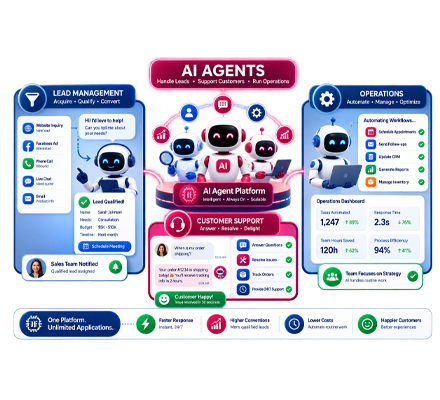
Put AI to work where your team spends time on repetitive tasks. Alyne builds AI agents that can respond to customers, qualify leads, schedule appointments, follow up, update your CRM, and keep routine work moving. Each agent is connected to the systems your business already uses and designed around specific tasks where faster response and less manual work make a real difference.

Businesses Growing With Our AI Agents

Businesses turn to Alyne to develop AI agents that can handle specific tasks, interact with customers, and work across the systems their teams already use. From lead qualification to customer support, we build agents around real workflows rather than adding AI where it does not belong.
Two Brothers Organic Farms
Riskwell
Reencle
Quality Plumbing Services
Paul Brothers Heating & Air
MAD Roofing
Kerrigan Roofing & Restoration
GigaStar
Ecocane
Eagle Eye Roofing
Adlib Advertising
Two Brothers Organic Farms
Riskwell
Reencle
Quality Plumbing Services
Paul Brothers Heating & Air
MAD Roofing
Kerrigan Roofing & Restoration
GigaStar
Ecocane
Eagle Eye Roofing
Adlib Advertising
Alyne Group develops AI agents for customer interactions, sales, support, operations, and internal workflows. Each agent is designed around a defined role, connected to the right business systems, and built with the actions, rules, and handoffs needed to work reliably in your day-to-day operations.

Our AI agent development services can help you:

Handle customer and lead conversations

Qualify and route incoming leads

Schedule appointments and follow-ups

Retrieve information from business systems

Update CRM records automatically

Assist teams with repetitive internal tasks

Connect AI agents with existing software and APIs

AI Agent Development Built Around Your Business

What AI Agents Can Take Off Your Team’s Plate

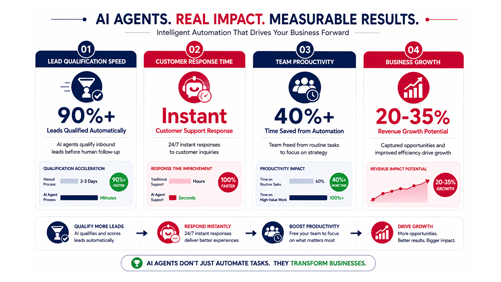
24/7
Customer Conversations
AI agents handle routine questions, collect information, and guide customers around the clock.
Minutes to Lead Qualification
Qualify incoming leads in real time, capture key details, and route opportunities without waiting for manual review.
100%
Follow-Up Coverage
Automate follow-ups based on lead activity, responses, timing, and predefined business rules.
10+
Hours Saved Weekly
Reduce repetitive CRM updates, data entry, and administrative tasks by letting agents capture and transfer information automatically.
5+
Systems Connected
Connect AI agents with CRMs, calendars, help desks, databases, and other business platforms to move information and trigger actions across systems.
80%+
Routine Requests Automated
Handle defined, repeatable customer and internal requests automatically while routing complex situations to your team.

AI Agents We Build for Real Business Work

AI agents can do more than answer questions. They can understand requests, use business data, follow defined rules, and take action. Alyne builds AI agents for customer interactions, sales, support, operations, and internal workflows, connecting them with the systems your business already uses.

01

AI Receptionist

Give every inbound call a response. AI receptionists can answer common questions, collect caller information, qualify opportunities, schedule appointments, and hand off calls when a person is needed.
02

AI Chatbot Development

Build a chatbot that does more than provide answers. We develop AI chatbots that understand customer requests, retrieve relevant information, guide users through processes, and escalate conversations when needed.
03

AI Voice Agents

Put an AI agent on the phone to handle defined conversations at scale. Voice agents can manage inquiries, qualification, scheduling, follow-ups, and other repeatable call workflows.
04

AI Workflow Automation

Let AI handle the steps between systems. We build agents that can trigger actions, move information, update records, send notifications, and keep multi-step business processes moving.
05

AI Agent Development

Build purpose-specific AI agents around the work your business needs handled. Agents can interpret information, follow business rules, use connected tools, complete tasks, and involve your team when human judgment is required.
06

AI App Development

Bring AI directly into your customer-facing or internal applications. We develop AI-powered products and features that can understand users, retrieve information, generate responses, and perform defined actions.
07

Custom LLM Integration

Connect language models to your business data and software. We build integrations that give AI access to the information and tools it needs to provide relevant responses and complete defined tasks.
08

AI SMS Automation

Turn text conversations into automated workflows. AI SMS agents can handle inquiries, reminders, confirmations, follow-ups, and lead conversations while passing important interactions to your team.
09

RAG & Knowledge Base Tools

Give AI access to the information your business actually uses. We build retrieval systems that connect agents to approved documents, knowledge bases, and internal information so they can find relevant answers before responding.

What Makes an AI Agent Actually Useful

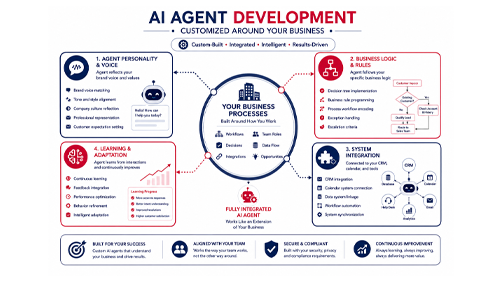
An AI agent is only valuable when it can work within your business, not just generate a response. We build the surrounding system so each agent knows what information it can access, what actions it can take, and when to involve your team.

Business Context

Your agent works from the information, processes, terminology, and requirements relevant to your business.

Defined Actions

We establish what the agent can actually do, from looking up records and booking appointments to updating a CRM or triggering a workflow.

Business Rules

The agent follows clear conditions for decisions, approvals, escalation, and customer interactions rather than improvising beyond its role.

Connected Systems

Agents can connect with CRMs, calendars, databases, communication platforms, APIs, and other software to complete work across your existing stack.

Human Handoffs

When a request falls outside the agent’s role or requires human judgment, the workflow can route it to the right person with the relevant context.

Testing and Optimization

We test agents against real scenarios, edge cases, and expected workflows, then refine their performance as your requirements evolve.

Build an AI Agent Around a Real Use Case

The strongest AI agent projects start with a specific business task, not a generic desire to “use AI.” We help identify where an agent can make a measurable difference and determine what it needs to know, decide, and do.
We can map out:

The task or process the agent should handle

The systems and data it needs to access

The actions it should be allowed to take

The metrics that will show whether it is working

What Businesses Say About Our AI Agents

Michael R.

Home Services

★★★★★

“Our AI agent handles inbound inquiries, qualifies new leads, and keeps the conversation moving before our team even gets involved.”

Jennah

Software and SaaS

★★★★★

“The AI agent takes care of routine customer questions and knows when to bring in our support team. It has made a noticeable difference in how our team handles incoming requests.”

Ellen John

Manufacturing

★★★★★

“We needed an agent that could work across our existing systems, not another standalone tool. Alyne built it around our workflow and automated several repetitive steps.”

AI Agents That Work With the Systems You Already Use

Your AI agent should fit into your business, not force your team to change everything around it. We build AI agents that connect with the CRM, communication tools, calendars, databases, and software your team already relies on. That means an agent can access the right information, take defined actions, and hand work to your team without creating another disconnected system.

AI agents can connect with:

CRM platforms such as Zoho, HubSpot, and Salesforce

Calendars and appointment scheduling systems

Help desk and customer support platforms

Websites, mobile apps, and internal software

Phone, chat, email, and SMS platforms

Each connection is designed around the agent’s role and the actions it needs to perform, so your existing systems remain part of the workflow.

Where AI Agents Can Make the Biggest Difference

The value of an AI agent comes from what it can actually do. An agent can qualify a lead, schedule an appointment, answer a customer, retrieve information, update a CRM record, send a follow-up, or pass a complex request to your team.
We identify the tasks where an agent can take meaningful work off your team’s plate, whether that means responding to leads faster, handling routine customer requests, coordinating appointments, or connecting several steps across your existing systems.

Our AI Agent Development Process

Building a useful AI agent starts with understanding the job it needs to perform. We define its role, connect the right systems, test how it handles real situations, and refine it before and after launch.

01

Define the Agent’s Role

We identify the specific work the agent needs to handle, the information it needs, and the outcomes it should achieve.
02

Map Tools and Actions

We determine which CRM, database, calendar, communication platform, or other system the agent needs to access and what actions it should be allowed to take.
03

Build and Test

We develop the agent, connect its tools, establish business rules, and test it against real conversations, workflows, and edge cases.
04

Launch and Improve

After deployment, we review performance, identify gaps, refine responses and workflows, and expand the agent’s capabilities as your business needs change. Start Your AI Agent Project

Custom AI Agents vs. Off-the-Shelf AI Tools

What Matters
Custom AI Agent
Off-the-Shelf Tool
Business Fit
Built around a specific role, workflow, and set of business rules.
Designed for a broad range of users and use cases.
Actions
Can be configured to perform defined tasks across your systems.
Usually limited to the actions supported by the product.
Integrations
Connects with the CRM, software, APIs, and data the agent needs.
Works primarily with its supported integrations.
Control
You define what the agent can access, do, and escalate.
Capabilities and controls are determined by the provider.
Growth
Can be expanded as new workflows and requirements emerge.
Changes depend on the product’s available features.

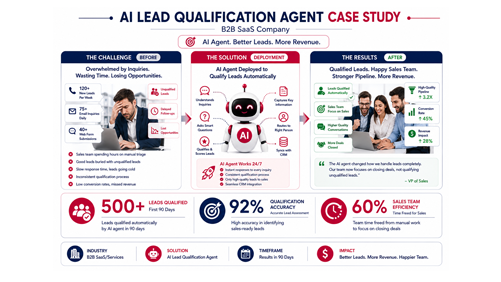
Case Study: AI Lead Qualification Agent for a B2B Company

A growing B2B company was receiving leads through its website and contact forms, but qualifying each inquiry manually was slowing the sales team down. We developed an AI lead qualification agent that could engage new prospects, ask relevant questions, collect key information, determine lead fit based on defined criteria, and pass qualified opportunities to the sales team.
The agent was connected to the company’s CRM and scheduling system, allowing each qualified conversation to move directly into the next stage without requiring staff to re-enter information.

Faster lead response
0 %
Saved each month on manual qualification
0 + hours

Industries Where AI Agents Can Do Real Work

AI agents can take on defined roles across industries where teams regularly handle repetitive conversations, information requests, qualification, scheduling, follow-ups, or internal processes.

What Your AI Agent Can Access

An AI agent is only as useful as the information and tools it can safely work with. We define what the agent can access, what it can do, and where human involvement is required before deployment.

Business Data

Access only the information required for the agent’s specific role.

Connected Systems

Integrate the agent with approved CRMs, calendars, databases, communication platforms, and APIs.

Defined Permissions

Limit what the agent can view, change, or trigger based on the workflow.

Conversation Records

Keep relevant interactions available in the systems your team already uses.

Human Escalation

Route sensitive, unusual, or complex situations to the appropriate team member.

Ongoing Control

Review the agent’s actions, refine its instructions, and adjust its capabilities as requirements change.

Give Your Team an AI Agent That Can Actually Work

Tell us what your team repeatedly handles, where conversations slow down, or which process still depends on manual effort. We can identify where an AI agent could take over specific tasks and map out what it would need to know, decide, and do.

Questions Businesses Ask Before Building an AI Agent

A chatbot primarily responds to messages. An AI agent can go further by using connected tools, following business rules, retrieving information, and taking actions. For example, an agent could qualify a lead, check a calendar, book a meeting, and update the CRM as part of one conversation.
The strongest use cases usually involve work that is repetitive, rules-based, frequent, and time-sensitive. Lead qualification, appointment scheduling, customer inquiries, follow-ups, information retrieval, and CRM updates are common examples.
For defined tasks, yes. An agent can operate automatically within the permissions and rules established for it. That does not mean every decision should be automated. Work that requires approval, sensitive judgment, or exceptions can be routed to a person.
Yes. An agent can be given multiple tools and responsibilities within a defined role. For example, a sales agent could answer an inquiry, qualify the prospect, check availability, schedule a meeting, and update the CRM.
It can be connected to approved business data and systems based on the scope of the project. Access can be limited to the information and actions the agent actually needs rather than giving it unrestricted access to your entire technology stack.
The agent can be updated as your workflows, services, systems, or business rules change. New actions, integrations, instructions, and escalation paths can be added as the agent’s role evolves.
Yes. Human handoffs can be built directly into the workflow. When an agent encounters a situation that requires a person, it can transfer the conversation or task along with the relevant information already collected.
Yes. The agent can be connected to existing CRMs, calendars, databases, communication platforms, APIs, and internal applications. This allows it to work within your current technology environment instead of operating separately.
We start with the process, not the technology. If a task requires repeated human effort but follows a predictable pattern, an AI agent may be a strong fit. If a process depends heavily on judgment or constantly changes, another approach may make more sense.

We’ll Call You – Submit to Connect

Your request has been submitted successfully!

We’ll Text You – Submit to Start

Your request has been submitted successfully!

Let’s Connect via Email!

Powered by Alyne